
-
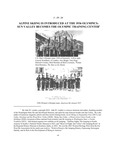
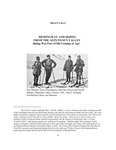
PILGRIMAGE TO OSLO’S HOLMENKOLLEN SKI HILL AND MUSEUM: T ORBJORN YGGESETH STARS FOR NORWAY AND THE UNIVERSITY OF WASHINGTON
John Lundin
Author describes his visit to the Holmenkollen Ski Hill and Museum and describes Torbjorn Yggeseth's competition in the northwest.
-
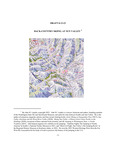
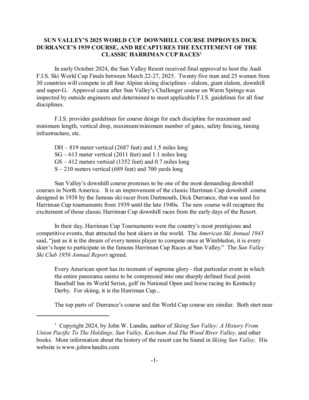
SUN VALLEY’S 2025 WORLD CUP DOWNHILL COURSE IMPROVES DICK DURRANCE’S 1939 COURSE, AND RECAPTURES THE EXCITEMENT OF THE CLASSIC HARRIMAN CUP RACES
John W. Lundin
In early October 2024, the Sun Valley Resort received final approval to host the Audi
F.I.S. Ski World Cup Finals between March 22-27, 2025. Twenty five men and 25 women from
30 countries will compete in all four Alpine skiing disciplines - slalom, giant slalom, downhill
and super-G.
-
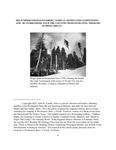
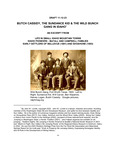
SKI JUMPERS FROM KONGSBERG, NORWAY, DOMINATED COMPETITION 1938 - RUUD BROTHERS TOUR THE COUNTRY DEMONSTRATING THEIR SKI JUMPING SKILLS
John W. Lundin
This essay was written for the Norsk Bergverksmuseum (Norwegian Mining Museum) in
Kongsberg, Norway to provide a brief history of some of the ski jumpers from that small town
who competed in the U.S. and dominated the sport from the 1920s through the 1940s. This was
known as the Kongsberg Era, and the Kongsberg technique of ski jumping, developed by the
Ruud brothers, was the style used by most competitors.
In summer 2025, Mining museum staff contacted the Washington State Ski and
Snowboard Museum seeking information about ski jumping trophies in their collections that
were won by Kongsbergers in tournaments held in Washington state.
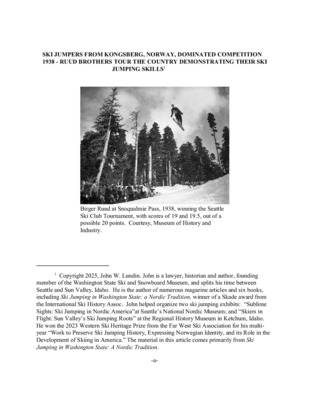
Skiers from Kongsberg dominated ski jumping in the Northwest in the 1930s and 1940s.
These include three jumpers from Vancouver, B.C., Nordal Kaldahl, Tom Mobraaten and Henry
Solvedt, known as the “Three Musketeers;” Sigmund and Birger Ruud; Roy Mikkelsen; Hjalmar
Hvam; Petter Hugstad; and a number of members of the famous Ulland family - Sigurd, Olav,
Arnie, Reidar and Ragnar Ulland; and others.
-
SUN VALLEY’S 2025 WORLD CUP DOWNHILL COURSE IMPROVES DICK DURRANCE’S 1939 COURSE, AND RECAPTURES THE EXCITEMENT OF THE CLASSIC HARRIMAN CUP RACES
John W. Lundin
In October, a delegation from the F.I.S. and US Ski & Snowboard (the country’s national governing body for skiing and snowboarding) gave final approval for the Sun Valley Resort to host the Audi F.I.S. Ski World Cup Finals between March 22-27, 2025. Twenty five men and 25 women from 30 countries will compete in all four Alpine skiing disciplines - slalom, giant slalom, downhill and super-G. International attention will be on Sun Valley, as European greats and their teams come for the tournament, and 2 million people are expected to watch the event in the U.S. alone. The final approval was based on the completion of the new Challenger race course on Warm Springs, which promises to be one of the most demanding downhill courses in North America. The name Challenger is a tribute to the Union Pacific Railroad and its Board Chair Averell Harriman, who built Sun Valley in 1936 as America’s first destination ski resort, and to the railroad’s Challenger railcars. In the 1930s, Challenger cars were part of U.P’s “age of streamliners,” luxurious and fast new trains made of aluminum and diesel powered that revolutionized passenger service. They “weren’t mere transportation — they were sophisticated hotels and restaurants on wheels,” with observation cars resembling the “parlor of a Gay Nineties madam.” The name also honors the resort’s new state-of-the-art Challenger chairlift, which serves Warm Springs and the new race course.
-
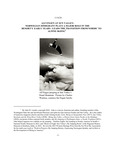
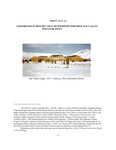
ALF ENGEN AT SUN VALLEY: NORWEGIAN IMMIGRANT PLAYS A MAJOR ROLE IN THE RESORT’S EARLY YEARS - LEADS THE TRANSITION FROM NORDIC TO ALPINE SKIING
John W. Lundin
Alf Engen (1909-1997) immigrated to the U.S. from Mjondalen Norway in 1929,becoming the country’s best ski jumper and Four-Way competitor in the 1930s and 1940s. Alf was the oldest of the remarkable Engen family, that included his brothers Sverre and Karre(Corey). Alf was one of the pioneers who led the transition from Nordic events that dominated skiing in the early years, to alpine skiing in the latter part of the 1930s, along with Birger and Sigmund Ruud, Roy Mikkelsen, Hjalmar Hvam and others
-
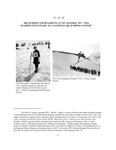
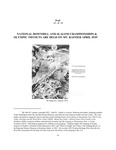
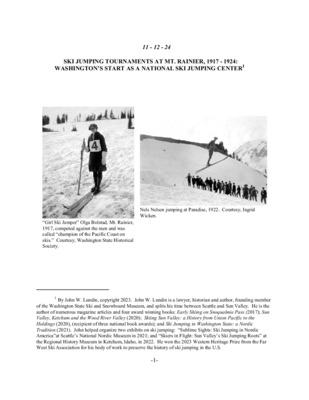
SKI JUMPING TOURNAMENTS AT MT. RAINIER, 1917 - 1924: WASHINGTON’S START AS A NATIONAL SKI JUMPING CENTER
John W. Lundin
SKI JUMPING ORIGINATED IN NORWAY & WAS BROUGHT TO THIS COUNTRY BY IMMIGRANTS Ski jumping originated in Norway, where it was part of normal skiing. National championship tournaments have been held at Oslo’s Holmenkollen Hill since 1892, with the winner getting the King’s Cup. Immigrants brought the sport to this country. Between 1870 and 1910, 1.5 million Scandinavians immigrated to the U.S., most settling along its Northern Tier. By 1930, 1.1 million residents were born in Norway or had parents that were, and 47% lived in New York City, Minneapolis or Seattle.
-
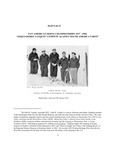
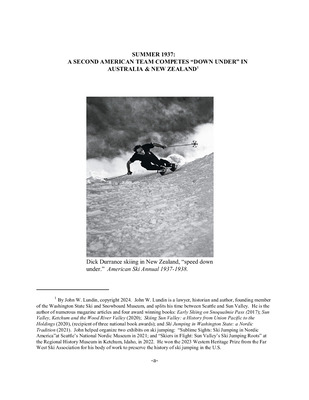
SUMMER 1937: A SECOND AMERICAN TEAM COMPETES “DOWN UNDER”
John W. Lundin
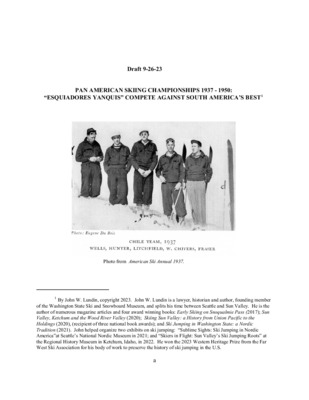
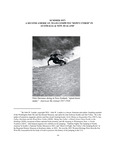
During the summer of 1937, two American ski teams competed outside the U.S. One team raced in Chile in the first Pan-American Skiing Championship, a competition that lasted until 1950, that pitted the “Esquiadores Yanquis,” an officially sanctioned U.S. F.I.S. ski team, against South America’s best skiers. See my article, “Pan American Skiing Championships,” Skiing History, November-December 2023. That team consisted of Seattle’s Don Fraser and five members of the Dartmouth ski team, three of whom were on the 1936 Olympic team - Fraser, Warren Chivers and Ted Hunter.
-
Stories about the David Rowlands Family of Ellensburg, Washington
Joy Main Smith
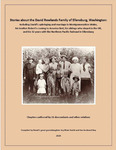
Including David's upbringing in Montgomeryshire Wales, his brother Robert's coming to America first, his siblings who stayed in the United Kingdom, and his 32 years with the Northern Pacific Railroad in Ellensburg.
-
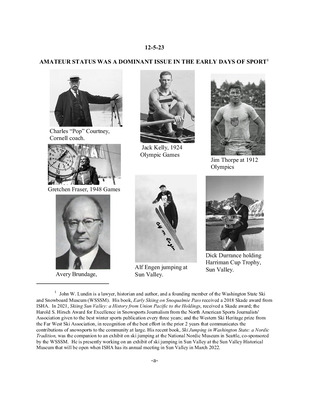
AMATEUR STATUS WAS A DOMINANT ISSUE IN THE EARLY DAYS OF SPO
John W. Lundin
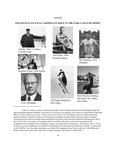
In the late 1800s, professional sports attracted high-stakes gambling. The potential for bribery and extortion led to a general sense that paid athletes were corruptible and competitions untrustworthy. While betting on amateur events was common, a deep divide emerged between "pure" amateurs, who were said to compete for the love of the sport, and professionals, who competed for money in the form of cash prizes or other remuneration. This prejudice even extended to coaches who had been professionals, who were believed to be too tainted to coach amateurs. The distinction often boiled down to so-called gentleman-athletes, who had private fortunes, versus working-class athletes, who had to earn money to live and train. Sport governing bodies consisted almost exclusively of gentlemen, who often preferred not to compete with working people. Sports associations in sports such as rowing, skiing and the Olympic Games were quick to outlaw those perceived as “professionals” to keep competition limited to true amateurs. This resulted in much hypocrisy and discrimination over the years.
-
WASHINGTON SKIERS IN THE 1936 WINTER OLYMPIC GAMES
John W. Lundin
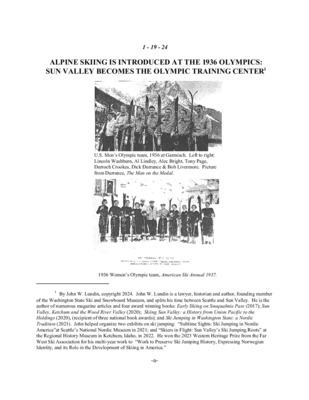
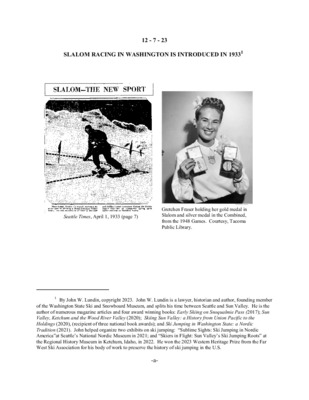
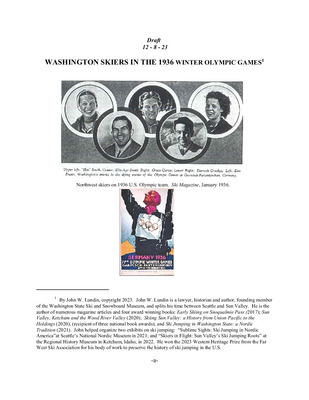
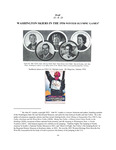
The 1936 Winter Olympics featured Alpine skiing for the first time, with downhill and slalom racing and a combined event (downhill and slalom), along with Nordic events (cross-country, Nordic combined, and jumping). Men and women competed in the Alpine events, although only men were allowed in the Nordic events.
-
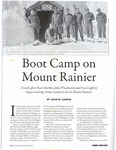
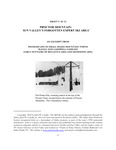
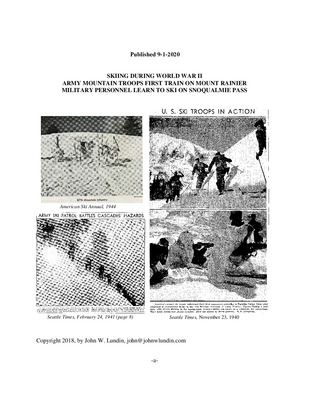
Boot Camp on Mount Rainier
John W. Lundin
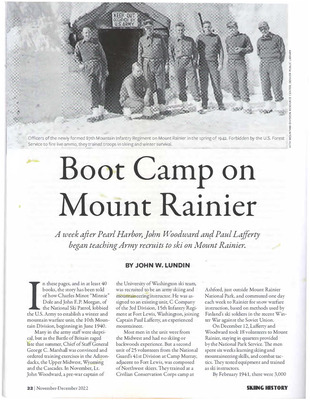
A week after Pearl Harbor,John Woodward an.fl, Paul Lafferty began teaching Army recruits to ski on Mount Rainier.
This gallery contains works by authors from the greater Central Washington area.
Printing is not supported at the primary Gallery Thumbnail page. Please first navigate to a specific Image before printing.